
Blog
INCI: what is it and how do you read it?
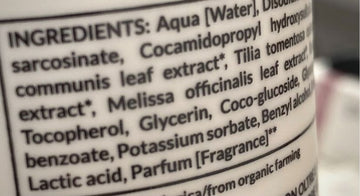
You know that list of ingredients with often long and complex names you find on the back of cosmetic products? That list is called INCI, which stands for "International Nomenclature of Cosmetic Ingredients ."
Introduced by the European Commission in January 1997, it was subsequently adopted by other countries such as the United States, Russia and China.
The INCI lists all the ingredients contained in a product in descending order . Therefore, those present in the greatest quantities are listed first. As you go further down the list, the percentage of each ingredient in the formula decreases, until you reach those present under 1%, which can be listed in any order at the bottom of the list.
Obviously, the precise quantities of each ingredient cannot be indicated as this is part of the formulation secrecy.
This particular "vocabulary" dates back to the 1970s and is constantly updated. All ingredients used in cosmetics must have an INCI name.
When a manufacturer intends to market a new cosmetic raw material for the first time, it must first apply for a specific name from the Personal Care Products Council . This is the body that assigns INCI names and the one to refer to to find out whether a certain wording is already present in the existing list of ingredients.
The body in question does not express an opinion on the quality or safety of the ingredient, it only assigns a name to indicate and recognize it.
But why create this “vocabulary”?
The purpose of the INCI is to protect consumers. Companies are required to list each ingredient in their products with the internationally recognized name. This means having a common language for any product made in a country that adopts the INCI.
This makes it easier for consumers to understand the ingredients in a cosmetic, allowing them to first identify the ingredients to which they are allergic or intolerant and, second, to make more informed choices. By analyzing the ingredients, consumers can determine whether a product advertised as "natural" truly is.
It is not an easy analysis to do for a non-expert, but there are tools that can help you understand the list of ingredients such as, for example, the Biodizionario or InciBeauty .
Generally speaking, the "rules" by which ingredients are reported in the INCI are these:
- Anything written in Latin is of plant origin. Plant extracts, for example, are listed with the botanical name of the plant. This is usually followed by the specific part of the plant used, written in English. For example, you might find Prunus armeniaca (Apricot) fruit extract, Prunus armeniaca (Apricot) kernel oil, and Prunus armeniaca (Apricot) seed powder. In all three cases, the ingredient is apricot, but the first refers to the fruit extract, the second to the kernel oil, and the third to the seed powder.
- Substances that have undergone a chemical transformation are written in English, except for the word Parfum (perfume) which is written in French.
- Dyes, even non-synthetic ones, are indicated by the acronym CI ( color index ) followed by the identification number. This category does not include dye plants (which are included in category 1) as they are complexes of natural active ingredients, including pigment; they are therefore not just "a color," but have many other components combined. If only the plant pigment were extracted, then it would be classified in this category.
Making it a little more difficult to understand an ingredients list is the fact that the ingredients used are sometimes a combination of multiple INCI names. The individual names can be placed far apart in the list, making it nearly impossible to determine which raw material is the original ingredient.
A glycerine extract, for example, will consist of water, glycerin, and a plant. In the INCI, however, you won't find the final name of the extract, but rather the three individual ingredients listed separately.
Below is an example of an INCI listing for a product containing cucumber glycerine extract. The underlined ingredients are those that make up the extract, which, as you can see, are listed individually.
In general, however, with the help of the internet and specific pages such as those already suggested above, you can get an idea of the quality of the product you intend to purchase.
The INCI is therefore a fundamentally important tool both for companies, because it demonstrates their transparency, and for consumers (indeed, especially for the latter) for their protection.


